I mentioned writing rules in the previous post, so I decided to add a submission rule. Just because I happen to come across it today.
Okay, this would be funny if it wasn't sad.
Slush God wrote today of "the most obnoxious slush submission EVER."
Apparently someone added little shiny stars to his/her submission and they were sticky to boot.
I can just imagine an editor opening an envelope of a submission and out fly confetti and fall all over the editor, her desk, the floor, her hair. That submission goes straight into the garbage with the confetti, without even looking for the SASE.
Which reminds me of another story I've heard, this time about an emailed submission where the writer introduced himself and the story for more than 500 words (how great he and his story is).
Anyway, two minutes later he sent another email. This time with the attachment of the story...
So don't be obnoxious, keep cover letters to the minimum necessary and be professional, which alas does mean - no confetti!
As I said, it would have been funny if it wasn't sad.
Categories: writing, submissions, publishing, business
Tuesday, February 28, 2006

Rules of Writing Fiction
Seems that lately I've been bringing one thing after another from GOB.
This time it's a reference to Elmore Leonard's ten rules of writing fiction. GOB doesn't say much about them it seems he agrees with the rules.
I read the rules in Elmore Leonard's site and while I tend to agree to one degree or another with most, I also know bestseller authors who break these rules regularly.
Of course Elmore Leonard does bring examples of authors who have "broken" these rules, and explains each rule in more details in his site so it is really worth to go and check out.
Elmore Leonard's ten rules:
1. Never open a book with weather.
2. Avoid prologues.
3. Never use a verb other than "said" to carry dialogue.
4. Never use an adverb to modify the verb "said" . . .
5. Keep your exclamation points under control.
6. Never use the words "suddenly" or "all hell broke loose."
7. Use regional dialect, patois, sparingly.
8. Avoid detailed descriptions of characters.
9. Don't go into great detail describing places and things.
10. Try to leave out the part that readers tend to skip.
We are also all familiar with Heinlein's Five Rules which I will bring through Rob Sawyer's site because he adds a sixth:
Heinlein's Five:
1. You Must Write
2. Finish What Your Start
3. You Must Refrain From Rewriting, Except to Editorial Order
4. You Must Put Your Story on the Market
5. You Must Keep it on the Market until it has Sold
Rob's Sixth:
6. Start Working on Something Else
Categories: writing, discipline, process, business
Writing News: J. B. MacKinnon Wins $25,000 for Literary Non-fiction
From the Globe and Mail - Story of murder wins $25,000
Categories: writing, news, contest
Charles Taylor non-fiction prize goes to author J.B. MacKinnon
J. B. MacKinnon, author of Dead Man in Paradise yesterday won the fifth Charles Taylor Prize for literary non-fiction -- and the $25,000 that goes with it.
Part mystery story, part travelogue, MacKinnon's book tells the story of the murder of his uncle, a Catholic missionary in the Dominican Republic 40 years ago, during a time of political upheaval.
Categories: writing, news, contest
Monday, February 27, 2006
Octavia Butler
Octavia Butler died on Friday.
From bloggers Nalo Hopkinson and The Valve.
From SFWA
Categories: writing, news
From bloggers Nalo Hopkinson and The Valve.
From SFWA
Categories: writing, news
Writing News: Dan Brown in Court for Copyrights Breach
Historians accuse Dan Brown of copyrights breach:
'Da Vinci Code' author accused of copyright breach
Historians take Da Vinci Code publishers to court
Dan Brown in court for Da Vinci Code copying case
Categories: writing, publishing, copyright, business, news
'Da Vinci Code' author accused of copyright breach
Historians take Da Vinci Code publishers to court
Dan Brown in court for Da Vinci Code copying case
Categories: writing, publishing, copyright, business, news
Leah McLaren About Blogs - Boring and Tedious
It is not often that I open the Globe and Mail and find a column about blogging.
I don't usually read Leah McLaren's columns as she writes in the entertainment section, a section I rarely get to.
But this column caught my eye. In this column about blogging McLaren explains why she "decided to swear off the blogosphere." Apparently, what got to her was a search in Technorati. She searched her own name and the names of several other writers she claims to know and admire. What she found was -
This hasn't been my experience. Not even close. In fact, quite the opposite. I find most bloggers to be encouraging and supporting toward other writers - published or not. And if someone doesn't like a book - what can be done?
I do agree with McLaren on one point - most blogs are boring and not well written:
But when McLaren asks why bloggers blog and reaches the conclusion that it's because what they write is unfit for publication, I disagree again. Not that what bloggers write is fit for publication, but that the reason doesn't have to be one or the other. I know many bloggers with no real aspirations in publication. But even the ones with such an aspiration don't necessarily blog what they would like to publish.
When McLaren asked a well established writer, David Eddie, why he blogs, here's what he had to say:
McLaren ends with some point about blogs being fragmented, not sphered, not connected. I'm not sure where she was going with that one.
However, what I found most interesting is that the reason McLaren swore off blogging in the first place was the slagging of writers by bloggers only to turn around and seem to do the same in her column. And as for editing - did she mean slagging or slogging? I still wonder.
Categories: writing, blogging, publishing
I don't usually read Leah McLaren's columns as she writes in the entertainment section, a section I rarely get to.
But this column caught my eye. In this column about blogging McLaren explains why she "decided to swear off the blogosphere." Apparently, what got to her was a search in Technorati. She searched her own name and the names of several other writers she claims to know and admire. What she found was -
... countless chat rooms full of bitter unpublished writers venomously slagging published ones -- their terrible spelling, poorly constructed sentences and outrageous amounts of displaced hatred and envy a testimony to why they became bloggers in the first place.
This hasn't been my experience. Not even close. In fact, quite the opposite. I find most bloggers to be encouraging and supporting toward other writers - published or not. And if someone doesn't like a book - what can be done?
I do agree with McLaren on one point - most blogs are boring and not well written:
The dominant quality is tedium: writers without editors, fact-checkers or paying subscribers to keep them in check. As Butterworth succinctly puts it: "If the pornography of opinion doesn't leave you longing for an eroticism of fact, the vast wasteland of verbiage produced by the relentless nature of blogging is the single greatest impediment to its seriousness as a medium."
But when McLaren asks why bloggers blog and reaches the conclusion that it's because what they write is unfit for publication, I disagree again. Not that what bloggers write is fit for publication, but that the reason doesn't have to be one or the other. I know many bloggers with no real aspirations in publication. But even the ones with such an aspiration don't necessarily blog what they would like to publish.
When McLaren asked a well established writer, David Eddie, why he blogs, here's what he had to say:
"It's a good way to limber up. You get up in the morning, fire up a blog, write the thing in 15 minutes and then you know what's on your mind. I think it was Nabokov who said, 'How do I know what's on my mind until I write it down?' "
McLaren ends with some point about blogs being fragmented, not sphered, not connected. I'm not sure where she was going with that one.
However, what I found most interesting is that the reason McLaren swore off blogging in the first place was the slagging of writers by bloggers only to turn around and seem to do the same in her column. And as for editing - did she mean slagging or slogging? I still wonder.
Categories: writing, blogging, publishing
Sunday, February 26, 2006
Fun Sunday - Escapa!
The Could You Have Been A Pilot Test?
Here's a game - Escapa! - that apparently the US Air Force uses for fighter pilots.
It is extremely simple, but it will drive you nuts.
I get the feeling guys will do better at this than women given their eye-hand coordination tends to better on average. (For all those who want to jump my throat - note that I said "on average" meaning there would be guys that suck at this and women that will do extremely well.)
It says that 18 seconds is brilliant.
I heard that 22 seconds is phenomenal.
And the pilots, you ask - they are expected to go for at least 2 minutes.
My best is 11.6 seconds but I have no patience for this, and it's not an excuse :)
Categories: fun, games
Saturday, February 25, 2006
If you were immortal - would you still have kids?
This whole thing started with Deborah Woehr. Deborah wrote a post Living to be 100? in which she referenced a Yahoo! article saying that "Life expectancy may balloon to 100 years old in rich nations thanks to scientific advances, but such progress could widen the gap between wealthy and poor nations, according to researchers."
Being the geek that I am, naturally I am familiar with the issue. I have written about it in July twice: Forever Young - Immortality and Bones, Cats and Shock Absorbers (please excuse the state of that blog I'm not sure what I'll be doing with it yet and it was inactive for about six months).
Being also the dense person that I am, I never thought it would interest people on this blog, but that was rather ridiculous of me to think, given the large amount of genre, especially sci-fi, writers out there.
So Lee Carlon and I hijacked Deborah's blog and started a little debate there.
In short, my point of view is that once we would become immortal or have a very extended life span, we would also fundamentally change, as individuals and as a society, probably beyond what we can imagine. For example, I offered, I doubt people would have kids.
If you recall my singularity post, I contended there that we couldn't possibly imagine now what our society would be like if we ever grow beyond our intelligence (and hence its affect on writers). Same thing with immortality, I say.
Lee's point of view was more cynical than mine (I am, after all, the eternal optimist). First, Lee offered that "we should be concentrating on ensuring everybody (in the world) has a good quality of life, before we reward ourselves with even more." And I fully agree with that. He's a better person than I am.
Second, Lee claimed that society is run on fear of not having enough and he thinks that this fear will only increase if we live forever and that our concern for others will further diminish. And this is where Lee and I differ.
Both Deborah and Lee also disagreed with me regarding people having kids. I know it's a hard concept to swallow, the notion that the thing that's been driving our society for thousands of years will be no longer, but if one thinks of the reason we were driven to procreate - for continuity - then that would no longer be an issue. Then why have kids?
Don't answer from the emotional point of view about how much kids mean to us. Remember, if you live to be 500, the time the kids are young is a speck.
As for the fears of not having enough resources to sustain one self as Lee suggested, I can offer this as a thought - if we're immortal, we take care of the one resource we always run out of - time. Once we feel, know that we have all the time in the world, and that seeing the Pyramids can wait another year or hundred, then our attitude changes. Dramatically.
Now go to Deborah's blog to continue the discussion there :)
Read the rest
Categories: science, immortality, science-fiction
Friday, February 24, 2006
So I was thinking...
About Tammy Nyp, gloating, science, Canada and etiquette
Remember how I promised myself at some point to keep with pop-culture events but never could really fulfill my promise?
Well, there is one thing I do to keep with events - I look at Technorati top searches. For the past week or so, probably more, something called Tammy Nyp was the top search. Being me I naturally assumed Tammy is a model/actress I never heard of and I left it that. But then, Tammy Nyp kept dominating the top searches. I mean, even when Britney gave birth she didn't dominate the searches for more than two days. Not Tammy. So I had to find out.
You're all probably laughing at my late catch-up, but for those even 'later' than me, apparently Tammy Nyp is some home porn video of two students and that was released without their consent over the internet. Feel free to correct me if I have it wrong.
So now I got it; now I understood. People want to watch the video. That's why they keep searching. Porn and sex have always dominated our society and always will. Maybe I should just write porn...
----------------------------------------------------
Then I noticed quite a gloating around as Frey was apparently dropped by his publisher. Yes, it made the news all over.
----------------------------------------------------
Speaking of gloating and adult footage, "Google could be forced to change its image search service following a court ruling in the US."
----------------------------------------------------
There was also some news about Shakespeare's mask. Apparently "SOME nifty detective work on a little-known bust from London strongly suggests that a 17th-century death mask really is that of William Shakespeare."
----------------------------------------------------
I mentioned blogging etiquette only two days ago, but I failed to discuss gladiator etiquette. Yes, apparently "real gladiators stuck to strict rules of combat and did not resort to the savage violence and mutilation typical of battlefields of the era." They even had two referees who enforced the rules. Well, I'll be darned, if gladiators had rules...
----------------------------------------------------
So... diet, eh? Apparently, a good idea. More than diet - starvation. Yes, indeed. As was found recently "A hormone that triggers hunger might also improve memory and learning - the substance improved mental performance in mice by up to 40%." I knew there was a reason I kept fighting with my mom not to eat. Alas, she kept feeding me.
----------------------------------------------------
Sometimes I worry. About many different things. I worry about our sun getting cooler for example. This is why I was so excited when I saw this: Enormous laser beam produces artificial star, or this: Man-made star shines in the southern sky. But it was just for some optics reason. Exciting, but not as much.
---------------------------------------------------
And for all those paleontologist wannabe out there, those who write "ancient sci-fi," nothing would make you happier, especially if you're Canadian, than the discovery of a Jurassic "Beaver" - the largest early mammal. But unlike our nice, vegetarian, Canadian beaver, this early one was a carnivore and had a poisonous spur on its ankle.
---------------------------------------------------
Finally, I ask you, if our own Milky Way galaxy steals stars, then what hope do we have to teach our kids morals???
Read the rest
Categories: writing, general, science, news
Thursday, February 23, 2006
A Short-Story Contest, Market and Script Writing Magazine
Compliments of GOB:
- A short story and poetry contest from King's Lynn Writers' Circle.
- A new magazine for those interested in writing screenplays: ScriptWriter Magazine
And compliments of Chris also a new publication: Jupiter World Press
Categories: markets, contests, writing, publishing, short-story, science-fiction, script
- A short story and poetry contest from King's Lynn Writers' Circle.
- A new magazine for those interested in writing screenplays: ScriptWriter Magazine
And compliments of Chris also a new publication: Jupiter World Press
Jupiter World Press publishes short fiction (up to 15,000 words) in the science fiction and fantasy genres. We welcome blends of genres, which include speculative elements, as well as those which cannot specifically be classified as either science fiction or fantasy.
Categories: markets, contests, writing, publishing, short-story, science-fiction, script
Wednesday, February 22, 2006
Blogging Etiquette
Okay, I'm not much for etiquette. I don’t usually mind how others behave but I do have my own “rules of engagement.” It's true, I don't cuss, don't use four-letter-words and in general try to be at the very least cordial.
But you know me, I love a good debate and don't shy away from arguments or controversies. In fact, quite the contrary.
I also write in a shared political blog where some of the other bloggers do not follow the same "etiquette" as I do, and that's fine by me. Usually on their posts one can find personal insults in the comments going back and forth, but nobody seems to mind. It's a certain style, I guess.
On my posts, however, no matter how controversial, the discussion tends to remain more civil. I once received a severe reprimand from someone for not quoting him properly, which I did apologise for given the sensitive subject matter. That was as harsh a comment as I ever got.
It therefore surprised me (very much) that of all places it was on this blog and on a benign post where I celebrated Canada's women hockey team success in the Olympics that I received the nastiest three comments yet. All from the same person.
This person deleted his own comments, it wasn't my doing. I still have them in my email. I left my own comment where I responded to his comment. Responded in kind. I left it because I have yet the felt the need to delete a comment I have written, and I still don't.
This brings me to etiquette:
Always make sure before posting a comment that you won't regret it later. If you have the slightest doubt, don't publish your comment. Wait a while, sleep on it if you have to, then publish.
Remember, a blog is not a forum. In a way, it is someone's personal space they've chosen to share. Behave on other blogs as you would want people to behave on yours.
Far be it from me to preach, but these were my 2 cents like it or not. It is, after all, my blog :)
Categories: blogging
Tuesday, February 21, 2006
Publishing 2010
I've been following a very interesting discussion among some big and medium guns on Google Book Search (GBS), copyrights and the future of publishing.
I wanted to summarize the articles and give you my opinion at the end (as I do like doing so often), but it's been three days that I have no time to write the proper post appropriate to opinionated self. So I'll just give you the headlines and hope to write about it properly some other time.
It all started (as far as my following the matter) with Cory Doctorow's article on Boing Boing Why Publishing Should Send Fruit-Baskets exactly a week ago. His article, obviously argues the case for GBS. In Doctorow true fashion, he shows how GBS can revive "dead" books and how free ebooks (along with GBS) can lift authors from obscurity.
Then, Michael Allen from GOB, referred to Doctorow's article only to refer to another article the next day. The article by Val Landy starts with a long description of the Great Barrier Reef, which in his eyes is "a perfect metaphor for the violent change and transformation the Web is having on all forms of media: music, film, newspapers, and soon, books."
Val Landy also bring two other changes/trends in addition to GBS: Amazon’s print-on-demand publishing company, BookSurge, and self-publishing (the likes of Lulu). He quotes Victor Keegan's article in the Guardian - Frustrated Author, Publish Yourself - [Are] “books about to go the same way as music and videos, with everyone able to publish from their back rooms, cutting out all the agents in the middle?”
So now I wonder. I've seen a few writers trying to sell their books using Lulu or Pdf downloads. Cavan, Benjamin and Chris are examples just off the top of my head and I'm sure there are many others. Not being an early adopter, I still hold on to traditional publishing, but it does seem the industry is changing.
Wouldn't it be nice one day not to get rejection letters?
Categories: publishing, writing, business
Oh, Canada - Women Hockey Team Wins Gold
I couldn't do much yesterday. First I was too nervous, then I watched, then I was ecstatic! And how!
This team is the best hockey team I've ever seen, men or women. They're amazing.
Thank you - Charline Labonté, Kim St-Pierre, Gillian Ferrari, Becky Kellar, Carla MacLeod, Caroline Ouellette, Cheryl Pounder, Colleen Sostorics, Meghan Agosta, Gillian Apps, Jennifer Botterill, Cassie Campbell, Danielle Goyette, Jayna Hefford, Gina Kingsbury, Cherie Piper, Vicky Sunohara, Sarah Vaillancourt, Katie Weatherston, Hayley Wickenheiser, ,Delaney Collins, Sami Jo Small and head coach Melody Davidson.
I just hope the men took notes...
Without words:

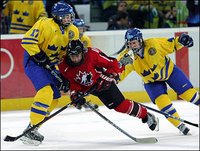

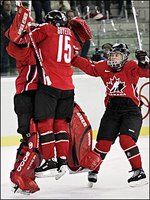




This team is the best hockey team I've ever seen, men or women. They're amazing.
Thank you - Charline Labonté, Kim St-Pierre, Gillian Ferrari, Becky Kellar, Carla MacLeod, Caroline Ouellette, Cheryl Pounder, Colleen Sostorics, Meghan Agosta, Gillian Apps, Jennifer Botterill, Cassie Campbell, Danielle Goyette, Jayna Hefford, Gina Kingsbury, Cherie Piper, Vicky Sunohara, Sarah Vaillancourt, Katie Weatherston, Hayley Wickenheiser, ,Delaney Collins, Sami Jo Small and head coach Melody Davidson.
I just hope the men took notes...
Without words:





Categories: Canada
Monday, February 20, 2006
Small Press Markets
Compliments of Miss Snark's post Avoiding the Dark Side. Miss Snark says these are "very good and legitimate smaller houses:"
Cavan from Blurred Line blog noted another good small-press market especially for SF&F:
Categories: markets, publishing, writing, novels, non-fiction, fiction, small-presssci-fi
- Ig Publishing - "alternative literary fiction that pushes the envelope in terms of language, sexuality or content," my favourite "highbrow literary fiction" and "political/cultural nonfiction with a liberal/progressive/radical/investigative edge to it. Anything too hot to handle, too controversial--we want it!" - guidelines
- MacAdam/Cage - "quality fiction and non-fiction" but not genre as far as I could tell - guidelines
- Akashic Books - guidelines (not accepting now, but have links to other publishers)
- SoftSkull Press - history, politics/current events, fiction, memoir/biography, music, poetry, art/graphics/comix, gay/lesbian, erotica - guidelines
- Bleak House - mysteries and literary fiction - guidelines
- Stonebridge - seems to be a publisher about everything Japan. From anime, non-fiction about Japan and literary books with a Japanese theme - guidelines
Cavan from Blurred Line blog noted another good small-press market especially for SF&F:
Categories: markets, publishing, writing, novels, non-fiction, fiction, small-presssci-fi
Sunday, February 19, 2006
Truman Capote - A Conceited Manipulative ****
A bit late, I know, but I finally went to see Capote last night.
Philip Seymour Hoffman is great. No doubt. I actually forgot I was watching a movie. It was gripping, interesting (redundant?), and emotional but not in a sappy way.
I had my misgiving before seeing the movie that I'd just keep laughing at Capote's high-pitched voice and way of talking, but it didn't bother me all that much while watching the movie. Okay, I did snigger a couple of times. Very mature, I know.
Anyway...
To be honest, I haven't read one Capote book yet and didn't really know what to expect. I knew nothing of his life and the only thing that hinted anything was the funny voice in the previews. (Sorry, I can't seem to get over that).
The movie did not present a pretty picture of Capote. He came across as very manipulative, conceited and proud, as well as egocentric and narcissistic. I had no idea he was friends with Harper Lee (I did read To Kill A Mockingbird ), and that was his best trait.
Capote was so engulfed in his own belief that he's God's given gift to humanity as an author that he forgot basic human feelings and decent behaviour. And this reminded me of our past week discussion re pretentious artists, ego, the One Ring, fallacies etc.
Of course, it isn't the same. A person with an ego with some merit, i.e. famous, successful and what not, vs. one before he's famous are two different things, but it still reminded me of our (sometimes passionate) debate.
Ego and the belief of being God given gift is not only authors’ domain, not only artists’ domain either. It is shared across all professions. Most CEOs are like that, most politicians and the list can go on.
I don't usually read or see movies about writers' lives. I don't really care what kind of person they are; I'm interested in their writing. So this movie was a change for me. I learnt about Harper Lee who was portrayed as sensible, sensitive and unassuming. Capote was portrayed as her opposite except for the sensitive part. He was sensitive alright, but only to his needs and emotions.
I’m not sure I have a point somewhere in here, but I just wanted to share.
Categories: writing, general, movies
Philip Seymour Hoffman is great. No doubt. I actually forgot I was watching a movie. It was gripping, interesting (redundant?), and emotional but not in a sappy way.
I had my misgiving before seeing the movie that I'd just keep laughing at Capote's high-pitched voice and way of talking, but it didn't bother me all that much while watching the movie. Okay, I did snigger a couple of times. Very mature, I know.
Anyway...
To be honest, I haven't read one Capote book yet and didn't really know what to expect. I knew nothing of his life and the only thing that hinted anything was the funny voice in the previews. (Sorry, I can't seem to get over that).
The movie did not present a pretty picture of Capote. He came across as very manipulative, conceited and proud, as well as egocentric and narcissistic. I had no idea he was friends with Harper Lee (I did read To Kill A Mockingbird
), and that was his best trait.Capote was so engulfed in his own belief that he's God's given gift to humanity as an author that he forgot basic human feelings and decent behaviour. And this reminded me of our past week discussion re pretentious artists, ego, the One Ring, fallacies etc.
Of course, it isn't the same. A person with an ego with some merit, i.e. famous, successful and what not, vs. one before he's famous are two different things, but it still reminded me of our (sometimes passionate) debate.
Ego and the belief of being God given gift is not only authors’ domain, not only artists’ domain either. It is shared across all professions. Most CEOs are like that, most politicians and the list can go on.
I don't usually read or see movies about writers' lives. I don't really care what kind of person they are; I'm interested in their writing. So this movie was a change for me. I learnt about Harper Lee who was portrayed as sensible, sensitive and unassuming. Capote was portrayed as her opposite except for the sensitive part. He was sensitive alright, but only to his needs and emotions.
I’m not sure I have a point somewhere in here, but I just wanted to share.
Categories: writing, general, movies
Saturday, February 18, 2006
Green Bin Protest
To those of you who don't live in the TO I have to explain Toronto's recycling policies, or rather, the very complicated garbage policy:
 And now (a few months ago actually) they've added,
Well, I've had it!
We have a pick up calendar of what is being picked up when and I also feel like I spend too much time sorting out my garbage. I have two smaller trash cans in the kitchen under the sink, one for the organics, one for not, and they go into their respective bigger trash cans. The problem with organic type garbage is that it leaks, smells and makes a hell of a lot of mess.
I know it's a sound environmental program, but it's just baaah.
I officially had it !
And thanks for listening.
Now excuse me while I go clean and disinfect.
Categories: personal
- Garbage Can is only for your regular run-of-the-mill garbage, which is what's left after you made sure you couldn't put it in one of the four other boxes/bins/bags:
- Grey Box - paper and cardboard and such
- Blue Box - plastic, cans, glass
- Garden bag - garden trash, you know, leaves etc.
 And now (a few months ago actually) they've added,
- Green Bin for organics such as food leftovers, fruits and veggies, paper towels, you know, all the kitchen yuckies
Well, I've had it!
We have a pick up calendar of what is being picked up when and I also feel like I spend too much time sorting out my garbage. I have two smaller trash cans in the kitchen under the sink, one for the organics, one for not, and they go into their respective bigger trash cans. The problem with organic type garbage is that it leaks, smells and makes a hell of a lot of mess.
I know it's a sound environmental program, but it's just baaah.
I officially had it !
And thanks for listening.
Now excuse me while I go clean and disinfect.
Categories: personal
Friday, February 17, 2006
Publishing 101 - Short Stories
This morning I had a surprise in my Inbox. I received a 'Plea for Help' email:
So here's what I've got so far:
Let me start by saying something that may or may not be obvious. Publishing is a business just like any other. The reason I mention this first is that once you've decided to be published, your attitude and behaviour should be the same as if you were to approached any business dealing. That is - professionalism.
There are some rules to learn and follow, but once learnt, there's nothing to it (other than actually getting the acceptance letter).
Phew...Read the rest
Categories: publishing, beginners, writing
- Melly, I came across your blog and I liked your style.
- You seem very approachable [oh my] so I decided to ask for your help.
I've been writing for a while but lately I started toying with the idea of publication only I don't have a clue how to go about it. I have a few short stories that I think are good enough to be published.
So here's what I've got so far:
Let me start by saying something that may or may not be obvious. Publishing is a business just like any other. The reason I mention this first is that once you've decided to be published, your attitude and behaviour should be the same as if you were to approached any business dealing. That is - professionalism.
There are some rules to learn and follow, but once learnt, there's nothing to it (other than actually getting the acceptance letter).
- Make sure your story (manuscript in publishing lingo or ms. for short) is your best work and that it is as ready as you can make it - no misspellings, no grammar mistakes (that don't work) etc.
- Find a market. This is probably where most first time publishers get stuck, but with the internet today it can't be any easier. Almost all magazines you read or have heard of have a website. You need to find the writers guidelines in that website. Some will have a clear heading saying guidelines, but most magazines list them in the 'Contact Us' page. If they do not have the guidelines anywhere on their site you can either email the editor - be concise and write Guideline Request in your subject line, or you can snail mail the editorial department - attach a Self Addressed Stamped Envelope (SASE) and ask them for the guidelines.
Here are a few websites that contain markets lists (a list of publishers and/or guidelines): Ralan, A list of market lists, Literary markets.
And then there are these wonderful books: Novel & Short Story Writers Market 2006 (Novel and Short Story Writer's Market)and 2006 Writers Market (Writer's Market)
- Follow the guidelines to the letter. If the publication doesn't want stories over 5,000 words, don't send it to them. If they want elf erotica, then that's all they're accepting. Don't waste their time and your time when your ms. can be circulated elsewhere. Make sure you send during a reading period, address your email to the right person, etc. All things professional. And most important, know your market, that is, read at least one copy.
- Prepare your manuscript. There are two general ways to format a manuscript, one for e-zines and one for print magazines. Here is the SFWA standard and here's an example from Rob Sawyer of this format. There might be small differences, don't sweat them. Strange Horizons, however, an e-zine, wants a different format and there's an example there too.
- cover letter. Keep it short. Something like - enclosed is XXX for your consideration. If you have any publishing credits you can list a few. Nothing more.
- submit your manuscript: in the body of the email, as RTF attachment, Word attachment, snail mail with a SASE, using an online form, whatever and however the editor requires.
- query. If sufficient time has passed (usually the guidelines indicate the time) and you have yet to receive an answer, send a polite query. Be concise, polite and don't forget to add your name and the name of your story.

Some lingo:
- Simultaneous submissions or sim sub - meaning sending the same ms. to a few publishers at the same time.
- Multiple submissions - sending more than one ms. to the same publisher.
- Payment on publication - you will receive payment when the story is published.
- Payment on acceptance - you will receive payment when the story is accepted.
Phew...Read the rest
Categories: publishing, beginners, writing
Thursday, February 16, 2006
A Change of Pace: This is Canada
Lately I've been reading too many bloggers complaining or simply telling about snow and snow-storms and cold weather like it's a big deal.
Well, here's a normal Canadian scene I thought I'd share with you:
 Withrow Park
 Broadview Park
Well, here's a normal Canadian scene I thought I'd share with you:
 Withrow Park
This park is a five minutes walk from my house.
 Broadview Park
This park is ten minute walk from my house.
You'd notice there's no snow on the ground, due to a remarkably mild winter no one is complaining about. Today we have snow.
Tuesday, February 14, 2006
Kinds of Writers
My last post stirred quite a debate regarding formula/form/structured plotting.
Eric/Redchurch from Quantum gave us his final thoughts on the matter:
Since Eric put the question to everybody, I thought it only appropriate to post it and see the response.
I'll be the first to answer. I aim for art. I don't delude myself in thinking that I can actually produce art, but I want my writing to be the best it can be.
As far as sales go - I do think that good art can sell but those in the mid-range, the ones striving for it, don't sell that much. At the same time, those who do follow proven formulae sell much better. Yes, as you said, Eric, they work.
By the way, I remember writing a post on the matter not too long ago - Idol Writing - Compromising your Artistic Integrity.
Categories: writing, publishing, art
Eric/Redchurch from Quantum gave us his final thoughts on the matter:
I think part of it depends on how revolutionary or artistic you want to be.
I don't feel the need to reinvent the wheel. I just want to provide a story that's as entertaining as possible. To me that doesn't necessarily require re-invention. The aforementioned structures exist because they work.
For me that's good enough. I'd rather spend more time focusing on the branded and unique elements of my story than trying to significantly change the storytelling process itself.
I'm also not much Le Artiste. Art is not my concern. On one hand, I tend to think if you aim for that you're likely to fail. My other reason is that entertainment has more value than art to the casual reader. I'm approaching the craft from a pop/hit mentality.
They [readers] just want an entertaining story. So that's all I'm really concerned with. Admittedly short-sighted on the artistic front, but I'm not aiming for art.
That raises a question for all of you though. What are you aiming for?
Since Eric put the question to everybody, I thought it only appropriate to post it and see the response.
I'll be the first to answer. I aim for art. I don't delude myself in thinking that I can actually produce art, but I want my writing to be the best it can be.
As far as sales go - I do think that good art can sell but those in the mid-range, the ones striving for it, don't sell that much. At the same time, those who do follow proven formulae sell much better. Yes, as you said, Eric, they work.
By the way, I remember writing a post on the matter not too long ago - Idol Writing - Compromising your Artistic Integrity.
Categories: writing, publishing, art
Monday, February 13, 2006
12 Steps to a Novel / Screenplay
It was in May 2004 that I first came across Vogler's book: The Writer's Journey : Mythic Structure for Writers .
Vogler, a motion picture producer and a story consultant to major movie companies, lists 12 steps in his book to structure a good novel/movie. He gives examples from different movies. (While I know many like to illustrate literary issues through movies, I still think it is a strained relation-ship given the two media are so different.)
In any event, I thought I'd bring the 12 steps here. Vogler takes a whole book explaining them, I think they're pretty self-explanatory.
1. Ordinary World
2. Call to Adventure
3. Refusal of the Call
4. Meeting with the Mentor
5. Crossing the First Threshold
6. Tests, Allies, Enemies
7. Approach to the Inmost Cave
8. Ordeal
9. Reward (Seizing the Sword)
10. The Road Back
11. Resurrection
12. Return with the Elixir
This is not a formula, but a form, Vogler is quick to point out.
I'm not a big fan of 'writing books'. I prefer to learn by assimilation. That is, I prefer to read and learn from these fine examples (or not). But of course, each of us is different. Among those who read 'writing books,' the views range from the best book ever written on the craft to the worst one yet. Quite a range, although many think it is an improtant resource for writers.
To me, this 12 step program seems to apply more to adventure/fantasy movies/novels but Vogler gives examples even from The Full Monty. I guess one can tweak the meaning to apply it to other genres as well.
It is important to learn the 'craft' and to pay attention to what's going on, but it is also very important, in my opinion, to maintain a personality-uniqueness-originality.
Categories: writing, plot, process
.Vogler, a motion picture producer and a story consultant to major movie companies, lists 12 steps in his book to structure a good novel/movie. He gives examples from different movies. (While I know many like to illustrate literary issues through movies, I still think it is a strained relation-ship given the two media are so different.)
In any event, I thought I'd bring the 12 steps here. Vogler takes a whole book explaining them, I think they're pretty self-explanatory.
1. Ordinary World
2. Call to Adventure
3. Refusal of the Call
4. Meeting with the Mentor
5. Crossing the First Threshold
6. Tests, Allies, Enemies
7. Approach to the Inmost Cave
8. Ordeal
9. Reward (Seizing the Sword)
10. The Road Back
11. Resurrection
12. Return with the Elixir
This is not a formula, but a form, Vogler is quick to point out.
I'm not a big fan of 'writing books'. I prefer to learn by assimilation. That is, I prefer to read and learn from these fine examples (or not). But of course, each of us is different. Among those who read 'writing books,' the views range from the best book ever written on the craft to the worst one yet. Quite a range, although many think it is an improtant resource for writers.
To me, this 12 step program seems to apply more to adventure/fantasy movies/novels but Vogler gives examples even from The Full Monty. I guess one can tweak the meaning to apply it to other genres as well.
It is important to learn the 'craft' and to pay attention to what's going on, but it is also very important, in my opinion, to maintain a personality-uniqueness-originality.
Categories: writing, plot, process
Subscribe to:
Posts (Atom)